
REVIEW · DUBAI STREET FOOD TOURS
Discover Old Dubai Town, Souks, Street Food, Culture and History
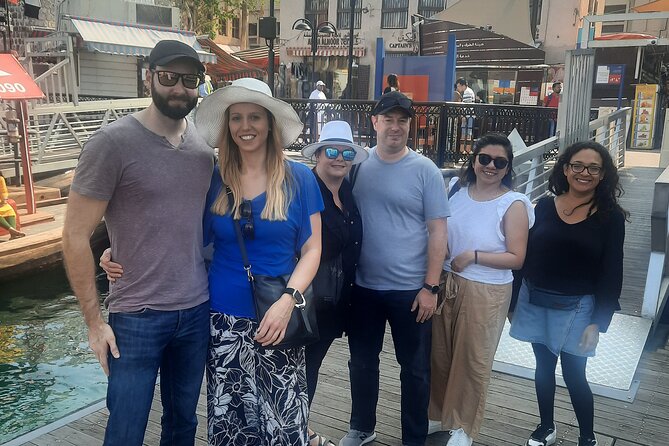
Dubai’s glass towers get the attention, but this tour takes you to the older city, where Dubai Creek still feels like the main street. You’ll walk through Al Seef and Al Fahidi, taste shawarma or falafel with Arabic tea, cross the creek by abra, then finish among the gold shops of Deira.
I like the mix of food and history, since you are not just looking at old buildings. I also like the small-group limit of 15, which helps guide Hesham Amin involve children and answer questions. The main drawback is pace: three hours covers a lot, so some stops are brief, and the Gold Souk visit is more of a short look than a full shopping session.
Key points to know before you book
- A practical Old Dubai introduction: You see Al Seef, Al Fahidi, the Old Souk, Spice Souk, and Gold Souk in one compact outing.
- Food is part of the tour: Choose Arabic falafel or chicken shawarma, then have Arabic tea, gahwa, refreshments, and camel milk chocolate.
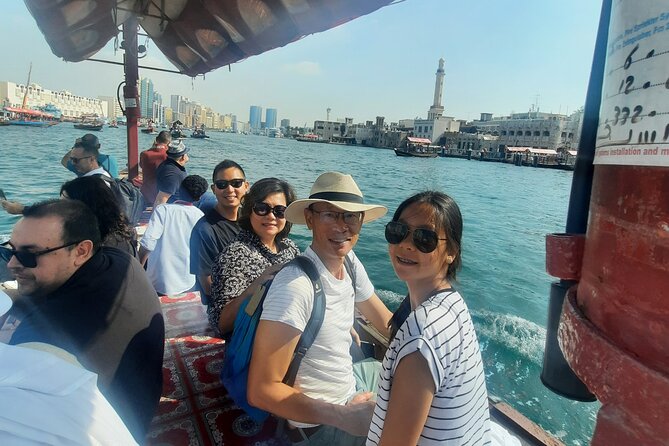
- A seven-minute creek crossing: The traditional abra ride links Bur Dubai with Deira and adds a pleasant change from walking.
- Guide-led and family-friendly: Hesham Amin uses questions and small interactive games to keep children involved.
- A useful end point: The tour finishes at Dubai Gold Souk, where you can continue exploring on your own.
- Good value at $27.91: The price includes the guided route, food tasting, drinks, abra ride, and several included stops.
Why Old Dubai makes a better starting point than another skyline view
You can see Dubai’s famous towers from many angles, often from air-conditioned malls or observation decks. This experience gives you a different key to the city. It shows how Dubai’s older neighborhoods grew around the creek, trade, courtyards, small shops, and daily movement between Bur Dubai and Deira.
You begin at Wokyo Noodle Bar in Al Seef. That meeting point is easy to identify within the Al Seef development, but do check the exact shop and arrive ready to walk. A mobile ticket is accepted, and confirmation comes at booking.
The group can reach a maximum of 15 people. That is not a private tour, but it is small enough for a guide to keep track of names and questions. Hesham Amin is specifically noted for making sure children take part, including ages 11 and 13, and for using simple games during the walk. That detail matters if you are booking for a family rather than a group of adults interested only in architecture.
The route lasts about three hours. It is not a museum-heavy tour or a long historical lecture. Instead, you get short walks, food, a boat crossing, and several quick stops that build a picture of the old city.
More Heritage Tours in Dubai:
- Dubai Old Town, Culture, History, Street food and Souks Tour
★ 5.0 · 170 reviews - Old Dubai Historic Guided Tour: Creek, Street Food & Souks
★ 4.9 · 156 reviews - Historic Ybor City Food Walking Tour
★ 5.0 · 2,210 reviews
Al Seef: a polished introduction beside Dubai Creek
The first stop is Souk Al Seef, a long waterfront district extending about 1.8 kilometers. Its design draws on older Dubai, but it is also a modern retail and dining area. You’ll see a blend of recreated traditional details and newer shops, with the creek providing the most convincing sense of place.
I like starting here because it gives you room to get your bearings. You can take photographs, look across the water, and begin thinking about Dubai as a creek port rather than only a city of skyscrapers.
The stop is listed at about 30 minutes. That is enough for a first look and some photographs, but not enough to cover the whole development. If Al Seef interests you, save time to return later. The tour’s purpose here is orientation, not a full shopping visit.
The area also introduces one of the tour’s themes: old Dubai is not preserved in one untouched block. Some places are historic, while others are modern interpretations of traditional design. A good guide can help you tell the difference, and Hesham’s role is especially useful here.
Al Fahidi’s wind towers, lanes, and courtyards
The route then moves into Al Fahidi Historical Neighbourhood, also called Bastakia in the tour description. This is where the walk becomes more clearly historical. Narrow lanes, traditional houses, shaded passages, wind towers, galleries, and cultural spaces replace the broad waterfront setting.
The wind towers are worth your attention. Before modern air-conditioning, these structures helped direct air into homes. They show that local architecture was shaped by heat, privacy, and practical needs, not just appearance.
You get two portions of time in Al Fahidi, one around 20 minutes and another around 30 minutes. The repeated neighborhood stop may feel slightly redundant on paper, but it reflects how much of the experience takes place here. The lanes are close together, and the guide can point out different buildings, architectural features, and cultural sites without rushing through the entire district at once.
I would listen for the everyday details. The value of Al Fahidi is not simply that the houses look old. The neighborhood helps explain how people lived, hosted visitors, worked, and adapted to the climate before Dubai’s modern expansion.
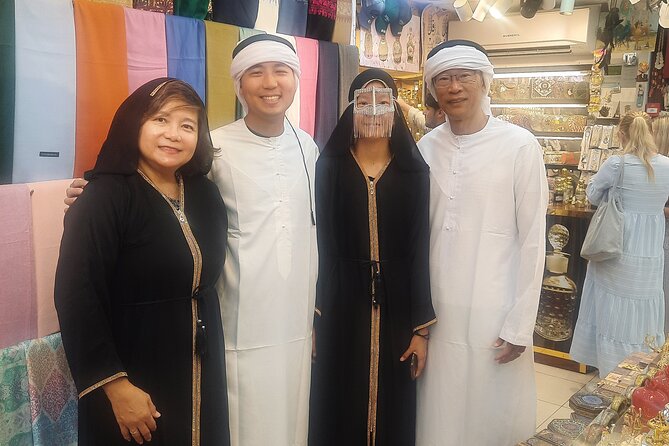
The tour also includes an opportunity to wear traditional Arabic clothing for photographs and experience Arabic hospitality with a cup of gahwa, or Arabic coffee. The coffee is a small detail, but it gives the history a social side. You are not only looking at a house or a wind tower. You are being introduced to a local custom.
Al Fahidi Fort and the Dubai Museum stop
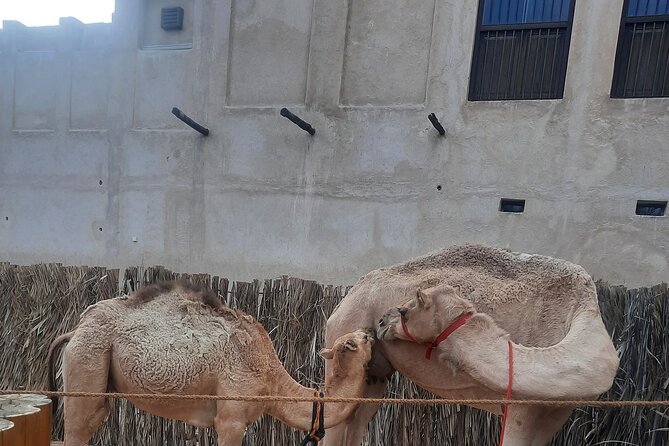
The next part is connected with Al Fahidi Fort and the Dubai Museum. The stated schedule allows about 30 minutes for this portion. The supplied details focus on the historic neighborhood, traditional homes, architecture, and Arabic coffee, so you should treat this as a guided heritage stop rather than assume a long museum visit.
That distinction is useful. Museum access and opening arrangements can change, while the fort and surrounding neighborhood remain central points of interest. The guide can place what you see in the wider story of Dubai’s transformation from a creek-based trading town to a global business center.
If you prefer a tour with long, quiet museum visits, this may feel too brief. If you want context while walking through the old quarter, the format works better. Hesham’s clear explanations are particularly important here. One family specifically valued the way he encouraged questions from children, and that is the sort of guidance that keeps a historical stop from becoming a list of dates.
A few more street food tours around Dubai worth a look
- Dubai: Old Town, Creek, Museums, Souks, & Street Food Tour
★ 4.8 · 10,816 reviews - Dubai: Old Town, Souks, Street Food, Guided Tour & Abra Ride
★ 4.9 · 7,170 reviews - Dubai: Old Town, Souks, Street Food, Guided Tour & Abra Ride
★ 5.0 · 1,664 reviews - Dubai: Old Town, Street Food, Creek, Souks, & Emirati House
★ 4.9 · 1,496 reviews
Old Souk food: choose shawarma or falafel by the creek
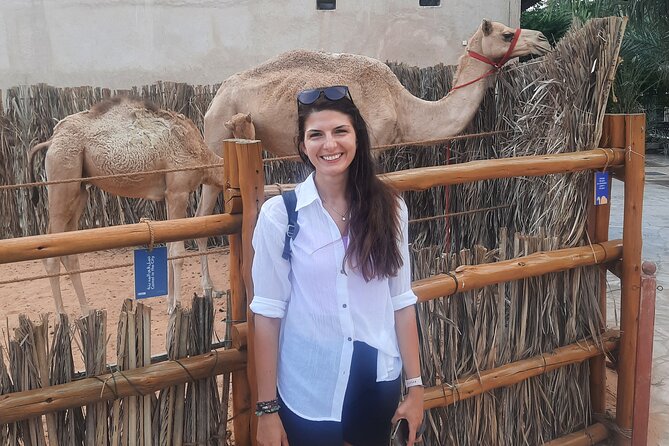
At the Old Souk, the experience shifts from buildings to food. You choose between Arabic falafel and Arabic chicken shawarma, with Arabic tea served alongside it. The meal is simple, but that is part of its appeal. You get a familiar local bite rather than a formal restaurant course.
Falafel suits vegetarians. Chicken shawarma gives you the meat option. The information provided does not specify additional dietary substitutions, so tell the operator about dietary needs before booking rather than counting on a change during the tour.
The setting adds real value. You eat with views toward Dubai Creek, where boats and waterfront activity provide a moving backdrop. This is one of the tour’s best pauses because it gives your feet a break and lets you absorb the setting without trying to take photographs at the same time.
The food stop is planned for about 30 minutes. That should be enough for the included tasting, tea, and a short rest. It is not a full food crawl, and you should not expect several dishes from different vendors. Think of it as one substantial snack within a history walk.
The abra ride: a short crossing with a strong sense of place
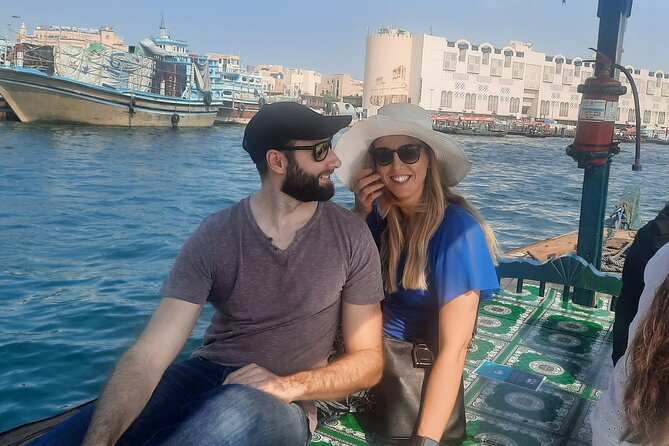
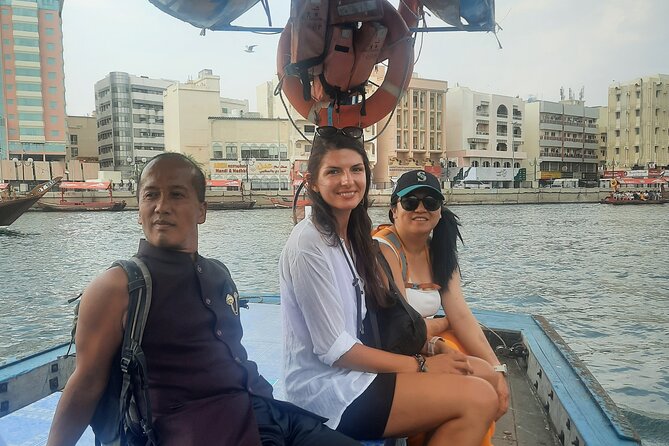
After the Old Souk, you walk to Bur Dubai Abra Station. The crossing itself is listed as about five to seven minutes, depending on the timing used in the tour details. You board a traditional wooden abra and cross Dubai Creek toward Deira.
This is one of the most effective parts of the route because it changes your view of the city. From the water, you can watch the waterfront from a lower, slower angle. You might see birds such as herons or kingfishers, depending on the season and conditions, but wildlife is not guaranteed.
Do not expect a long cruise. The abra is used as local transport, not as a sightseeing boat with a narrated circuit. That is precisely why the ride works. It is short, practical, and tied to the way the two sides of the creek connect.
You arrive at the Deira Old Souk Abra Station near the Gold Souk. The landing area can feel active, and you’ll notice the movement of the waterfront before heading into the markets. Since the boat ride is included, it adds useful transport as well as atmosphere.
Spice Souk: scents, color, and camel milk chocolate
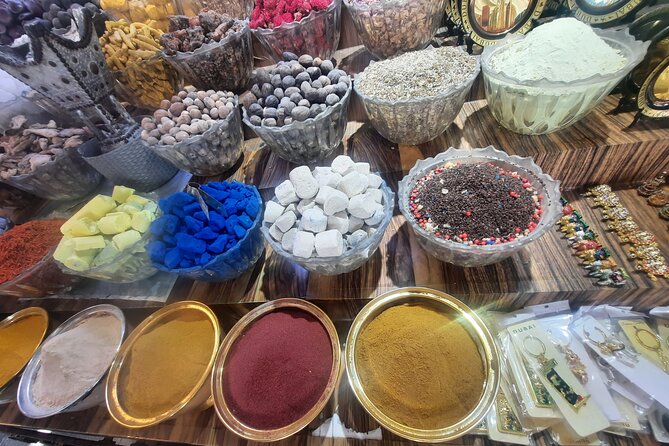
The Spice Souk gives you a quick sensory stop after the calmer creek crossing. You’ll walk among displays of spices and enjoy a refreshment, followed by camel milk chocolate, a local specialty that many visitors may not encounter elsewhere in Dubai.
The visit is scheduled for about 20 minutes. That is enough for a first look and a taste, but it is not enough for a slow market browse or serious spice shopping. If you want to buy something, use your time carefully and ask questions before committing to a purchase.
The souk is valuable because it connects trade, food, and place. The spices are not merely colorful props for photographs. They point to Dubai’s long role as a meeting point for goods moving through the region. Even a short stop can help you see the creek districts as working marketplaces rather than just heritage attractions.
The camel milk chocolate is a small but memorable local detail. You may enjoy it, or you may simply find it unusual. Either way, it gives the tour a food experience beyond the more familiar shawarma and falafel.
Gold Souk: a quick finish among elaborate displays
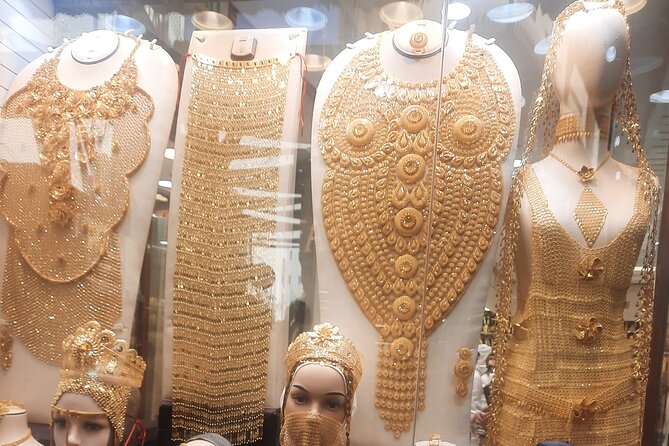
The final stop is Dubai Gold Souk. The scheduled visit is about 10 minutes, and the tour ends here. You’ll see shopfronts filled with gold jewelry, gemstones, and elaborate pieces of craftsmanship.
Ten minutes is enough to look at the displays and understand the scale and style of the market. It is not enough for a relaxed purchase, price comparison, or careful jewelry shopping. If you are considering buying gold, plan to return independently after the tour and allow much more time.
Ending here is convenient. You can continue exploring Deira, remain near public transportation, or make your own way back across the creek. The finish also gives the route a clear arc, from Al Seef and Al Fahidi on the Bur Dubai side to the commercial souks of Deira.
Keep expectations realistic. The Gold Souk is a visual finale, not a dedicated shopping consultation. That is a fair trade for a tour that already includes history, food, coffee, a boat ride, and two other markets.
What the $27.91 price really covers
At $27.91 per person, the price is reasonable for a three-hour guided outing. You are paying not only for someone to walk you through the neighborhoods, but also for the included food and drinks, Arabic coffee, camel milk chocolate, and abra crossing.
The value is strongest if you are new to Dubai and want several first impressions in one booking. You avoid having to work out the sequence between Al Seef, Al Fahidi, Bur Dubai, the creek, Spice Souk, and Gold Souk. The guide also adds historical context that can be hard to pick up while walking alone.
The value is less clear if you already know the old districts well or want extended market shopping. The schedule is tight, and the Gold Souk visit is short. Independent visitors can walk through many of these areas for little cost, but they will not automatically get the food, organized route, or storytelling.
Free cancellation is available up to 24 hours before the start time. Changes or cancellations inside that period are not accepted for a refund. Keep that deadline in mind when weather, flight delays, or family plans may affect your day.
Who will get the most from this three-hour route
I would recommend this experience to first-time Dubai visitors who want a break from malls and towers. It also suits families, especially because Hesham is described as involving children, remembering names, encouraging questions, and using small games.
It works well for people who like a little of everything. You get architecture, local customs, food, markets, water transport, and photographs without committing to a full-day excursion.
It may not suit you if you need a slow pace, extensive time in museums, or a serious shopping trip. The walk includes several stops, and some are short. Anyone with mobility concerns should check the route details directly before booking, since the experience uses neighborhood streets, souks, and an abra, and the provided information does not give specific accessibility details.
Should you book this Old Dubai tour?
Book it if you want an affordable, well-organized introduction to Dubai’s creek districts, with food and a guide doing the connecting work. The strongest reasons are the clear family focus, Hesham Amin’s interactive style, the included Arabic coffee and street food, and the simple abra crossing between the two historic sides of the city.
Skip it if your main goal is shopping or a long museum visit. For most first-time visitors, though, $27.91 buys a useful three-hour orientation and a more grounded look at Dubai than another ride to a high observation deck.
FAQ
How long does the Old Dubai tour last?
The experience lasts approximately three hours.
How much does the tour cost?
The listed price is $27.91 per person.
Where does the tour begin?
It begins at Wokyo Noodle Bar in Al Seef, at Al Hamriya, Al Seef, Heritage Village, P3, Shop 381, Dubai.
Where does the tour finish?
The tour ends at Dubai Gold Souk in Deira, in the Al Ras area of Dubai.
Is the tour available as a mobile ticket?
Yes. Mobile ticketing is available, and confirmation is received at the time of booking.
What food is included?
You can choose Arabic falafel or Arabic chicken shawarma. Arabic tea is included with the food stop.
Does the tour include Arabic coffee?
Yes. The experience includes Arabic gahwa, or traditional Arabic coffee, in the Al Fahidi area.
Is the abra ride included?
Yes. A short traditional wooden abra crossing from Bur Dubai to Deira is included.
What is the group size?
The tour can have a maximum of 15 people.
Just added around Dubai
- Old Dubai Walk, Souk, Street Foods, Al Fahidi and Al Seef Tales★ 4.0 · 9 reviews
- Original Street Food Tour of Dubai★ 4.5 · 41 reviews
- Private Dubai Street Food Tour .★ 4.5 · 7 reviews
- Dubai Street Food Tour★ 5.0 · 5 reviews
- Dubai Souks, Museum, Street Food Walking Tour with Hotel Transfer★ 4.5 · 7 reviews
- Local Street Food and Guided Walking Tour of Dubai Old Town★ 5.0 · 37 reviews
- Local Food Tour of Dubai★ 5.0 · 3 reviews
- Walking Tour in Dubai. Souks, museums, Local Food Testing★ 5.0 · 11 reviews
Dubai Street Food Tours, compared.
Dubai: Old Town, Souks, Street Food, Guided Tour & Abra Ride
Read our review →Dubai: Old Town, Souks, Street Food, Guided Tour & Abra Ride
Read our review →
Dubai: Old Town, Street Food, Creek, Souks, & Emirati House
Read our review →
Old Dubai: Premium Guided Tour with Street Food & Abra Ride
Read our review →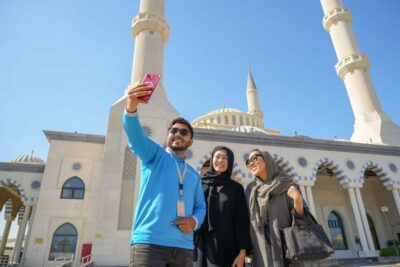
Dubai Top Highlights: Frame Entry, Souks, Abra & Street Food
Read our review →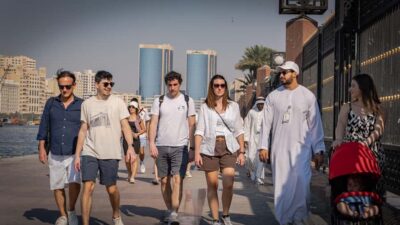
Dubai: Premium Old Town, Street Food, Souks & Boat Ride Tour
Read our review →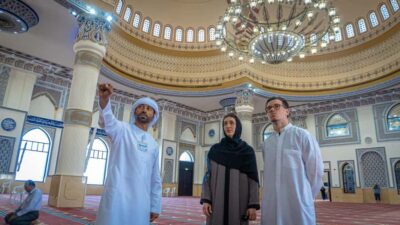
Dubai: City Highlights Tour with Blue Mosque & Street Food
Read our review →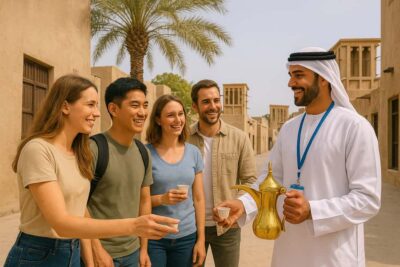
Dubai.Discover Old town,Markets,street food,Abra &Museums
Read our review →Browse the lists this tour appears in